For centuries, one of the most feared words a person could hear was the name of a disease that slowly numbed the nerves, scarred the skin, and reshaped the face and hands. In the Turkish-Islamic world that disease was called cüzzam – leprosy. Yet the way the Ottomans dealt with it tells a surprisingly humane story, one preserved today mostly in a single word – miskin – and in the ruins of a fountain hidden inside one of Istanbul‘s largest cemeteries. This is the history of leprosy in the Ottoman Empire: where its patients lived, how they were cared for, and what eventually happened to the “lodges of the listless.”
What Is Leprosy? A Disease as Old as Writing Itself
Leprosy, known in modern medicine as Hansen’s disease, is a chronic infection caused by the bacterium Mycobacterium leprae. It attacks the skin, the peripheral nerves, the eyes, and the lining of the upper respiratory tract. Because it destroys nerve endings and causes a loss of sensation, untreated patients can suffer progressive injuries and deformities to the hands, feet, and face.
It is also one of the oldest recorded diseases on earth, with descriptions reaching back to the cuneiform tablets of ancient Mesopotamia and to early medical texts of India, China, Egypt, and the Mediterranean world. For most of human history there was no cure – only fear, and the instinct to push sufferers out of sight.
That fear is the backdrop against which the Ottoman response stands out.
Why “Miskin”? The Word That Became the Name of a Disease
In Ottoman Turkish, the Arabic-rooted word miskin meant “poor, helpless, meek, listless.” Over time, that description seemed to fit the worn-down condition of leprosy sufferers so closely that the word itself drifted into a second meaning: a person afflicted with cüzzam. (The word cüzzam, too, comes from an Arabic root carrying the sense of “severing” a part of the body – a grim reference to the disease’s visible toll.)
From there, the language of leprosy spread outward. The buildings where patients were housed apart from the rest of society came to be called miskinhâne, miskinler tekkesi (“lodge of the miskin“), miskinler dergâhı, or meczûmîn zâviyesi. The Western term for such a place is leprosarium.
There’s a quirk of history buried here, too: because miskin also implied idleness, the phrase “miskinler tekkesi” eventually entered everyday Turkish as a put-down for any place of laziness – a meaning most modern speakers know far better than the original.
Why Were They Called “Lodges”? Dignity by Design
The choice of the word tekke – normally a dervish lodge – was deliberate and revealing. Leprosaria were often built near the tomb of a saint or holy figure and run in the style of a religious lodge, with a withdrawn, communal way of life that mirrored the seclusion of dervishes. The administrators were even given the title şeyh.
In an age when leprosy carried crushing social stigma, these naming choices were a quiet act of mercy. Calling the institution a lodge and its keeper a sheikh helped preserve the dignity of people whom society might otherwise have treated as outcasts.
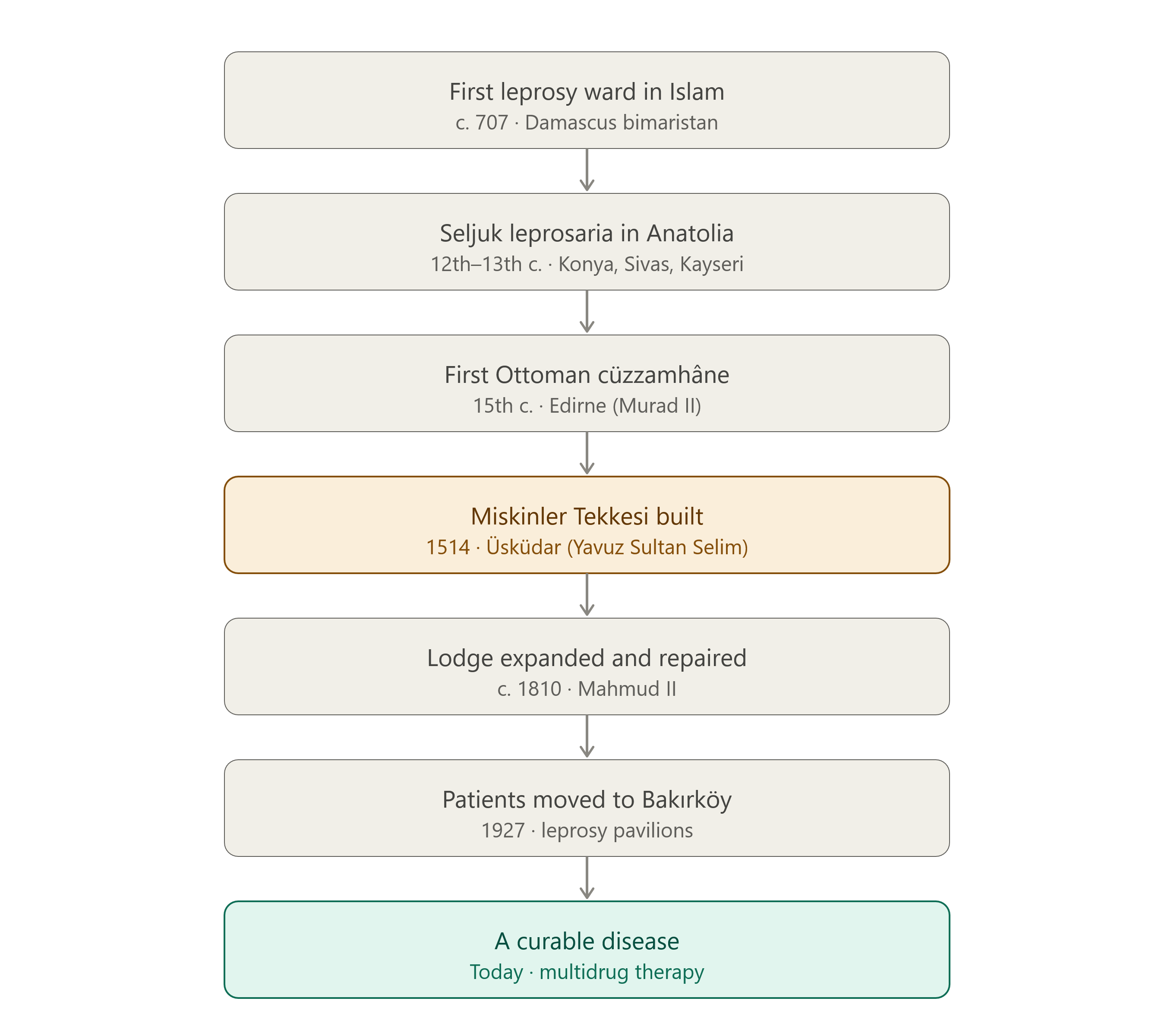
Timeline of leprosy disease in Ottomans
The Islamic and Seljuk Precedent
The Ottomans did not invent this approach. The first documented provision for leprosy patients in the Islamic world came centuries earlier, when the Umayyad caliph al-Walid ibn Abd al-Malik founded a bimaristan (hospital) in Damascus around 707 CE that set aside a section for those with the disease – often cited as the earliest leprosy-hospital arrangement in history.
In Anatolia, the Seljuks continued the tradition. Leprosaria – meczûmîn zâviyesi – operated in cities such as Konya, Kayseri, Sivas, Tokat, Amasya, Adana, and Kastamonu, each typically headed by a şeyh. Seljuk medicine even engaged the disease intellectually: the physician Kutbeddin-i Şirazi wrote a treatise on it. By the time the Ottomans inherited Anatolia, in other words, they were building on an established medical and charitable foundation.
The First Ottoman Leprosaria: From Edirne to the Empire’s Edges
The earliest Ottoman cüzzamhâne is generally credited to Sultan Murad II, who established one in the 15th century in the Kirişhâne quarter on the outskirts of Edirne. Others followed across the empire – in Üsküdar, Bursa, Nicosia (Lefkoşe), Candia (Kandiye), and Chios (Sakız), and over time in Kayseri, Safranbolu, Kastamonu, Konya, Gelibolu, and Marmara Island as well.
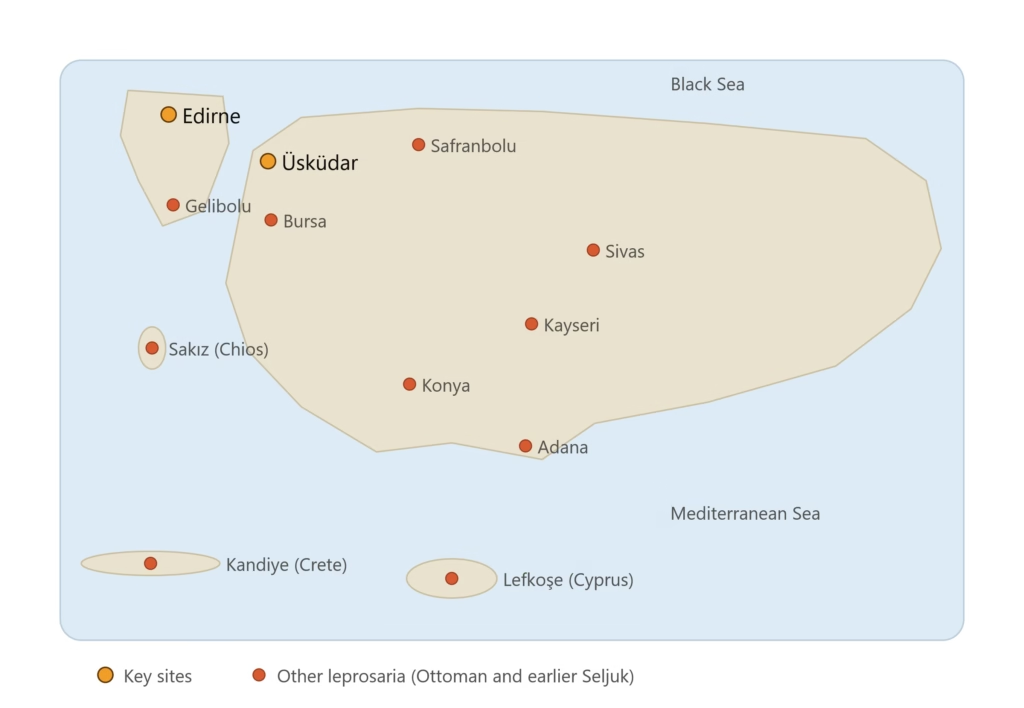
Leprosy lodges operated from Thrace to the Aegean and Mediterranean islands – Edirne and Üsküdar were the best known
The pattern was consistent: leprosaria sat on the edges of cities or just beyond them – close enough to be supported by the community, far enough to limit contagion. Crucially, these were not simply quarantine pens. They were chartered, funded settlements where residents’ needs were met and a sense of community could form.
Üsküdar’s Miskinler Tekkesi: The Empire’s Most Famous Leprosy Lodge
The best known of them all was the Miskinler Tekkesi at Üsküdar, built by Sultan Selim I (Yavuz Sultan Selim) in 1514, in the middle of what is now the vast Karacaahmet Cemetery, along the old road heading out of the city.
Its origins trace to a piece of Ottoman public-health legislation: a Kanunname of Bayezid II (around 1501) directed that lepers be removed from within the city. The lodge that resulted served a dual purpose – protecting the healthy population while sheltering people who had no place in ordinary society. The 17th-century traveler Evliya Çelebi described it in his famous Seyahatname, noting how anyone identified as a leper would be taken there, regardless of their rank.
How the Lodge Actually Worked
The Üsküdar complex grew over time into something like a small village. It began with around nine cells, each with its own hearth and a covered porch; under Mahmud II in the early 19th century, roughly eleven more dwellings were added, along with repairs that left behind a fountain still partly visible today. The site eventually included a small mosque, a bathhouse, and a laundry.
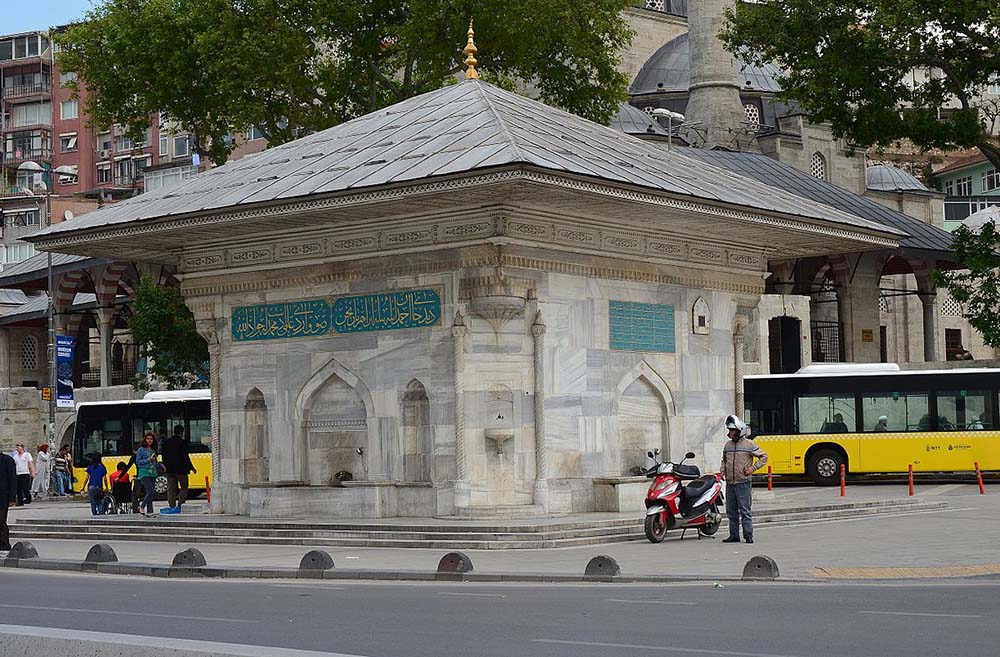
Ahmet the 3rd Fountain Üsküdar
Its day-to-day life was sustained by the Ottoman institution that made so much of this possible: the vakıf, or charitable endowment. The imperial endowments administration allocated funds so residents would not go hungry. Patients received bread, soup, rice pilaf, and meat from the nearby Üsküdar soup kitchen and associated foundations, with sweet zerde served on certain nights of the week. When donations dipped, the palace itself – sometimes the reigning sultan personally – covered the shortfall.
Two details capture the texture of life there especially well:
The alms-stones. In front of the lodge stood hollowed stones – sadaka taşları – where passersby left coins without ever needing to touch the residents. A watchman known as the gözcü dede would signal when money appeared; the community would offer prayers, and the şeyh distributed what had been collected.
A community, not just a confinement. Residents were permitted to marry one another, raise families, and build a life inside the walls. The Üsküdar lodge was, by Ottoman accounts, quite populous.
Compassion in an Age of Cruelty
What makes this history striking is the contrast with much of contemporary Europe. In many medieval European societies, leprosy sufferers were treated as cursed – branded as bearers of divine punishment, sometimes linked to sorcery, and driven not just out of cities but away from their outskirts entirely.
The Ottoman approach was certainly built on isolation, and the legal codes could be blunt about removing the sick from the city. But that isolation came wrapped in a framework of care: patients were classified as people in need, their livelihoods were guaranteed by the state and by endowments, and their dignity was protected through the language of lodges and sheikhs. Historians often describe institutions like the Miskinler Tekkesi less as prisons than as “nests of mercy” – semi-autonomous communities aimed at rehabilitation as much as containment.
It was, in short, a public-health policy with a conscience.
The End of the Lodges: Into the Republican Era
By the late Ottoman and early Republican periods, medicine was changing and the old lodges were fading. The Üsküdar patients were moved first to the Toptaşı hospital and then, in 1927, to dedicated leprosy pavilions at the Bakırköy hospital for mental and neurological illness in Istanbul.
The Miskinler Tekkesi itself, left empty, fell into ruin – damaged by fire and gradually erased, with the final demolition of the site tied to the construction of a ring road in the 1960s. Today almost nothing remains except a half-buried fountain (çeşme) from the Mahmud II–era repairs, a quiet survivor of a five-century institution. Its restoration inscription is held in the Museum of Turkish and Islamic Arts.
From these roots grew Turkey’s modern leprosy care. Organized national efforts intensified from the 1960s, and the Istanbul Leprosy Hospital at Bakırköy became a center for treatment, surgery, eye care, physiotherapy, and rehabilitation. Historically, most of Turkey’s registered patients came from the eastern provinces, where the disease was more prevalent, before many resettled in the west.
Leprosy Today: A Curable Disease
The most important thing to know about leprosy now is that the fear is largely a relic. It is one of the least contagious of the well-known infectious diseases, spreading only through prolonged close contact, and – since the development of modern multidrug therapy (a combination of dapsone, rifampicin, and clofazimine) – it is fully curable. The World Health Organization has provided this treatment free of charge for decades.
Globally, leprosy was eliminated as a public-health problem (defined as fewer than one case per 10,000 people) around the year 2000, though it has not vanished – roughly 200,000 new cases are still reported worldwide each year, mostly in other parts of the world. In Turkey, new cases have become rare, and the disease that once filled an entire lodge in Karacaahmet is now a manageable, treatable condition.
The deformity, the dread, the lifelong exile – all of it, today, is history.
A Word Left Behind
Walk through Karacaahmet Cemetery today and you will pass, without knowing it, the ground where tens of thousands of “miskin” once lived, married, prayed over alms-stones, and were cared for by an empire that – for all the fear the disease inspired – chose mercy over abandonment. The lodge is gone. The word remains. And in that single word, miskin, an entire chapter of Ottoman social welfare quietly endures.
Frequently Asked Questions
What was leprosy called in the Ottoman Empire?
Leprosy was known as cüzzam, and its sufferers were called miskin – a word originally meaning “poor” or “listless” that came to stand for the disease itself. The institutions that housed patients were called miskinhâne, miskinler tekkesi, miskinler dergâhı, or meczûmîn zâviyesi.
What was the Miskinler Tekkesi?
It was a leprosarium – a sheltered community for leprosy patients. The most famous one was built by Sultan Selim I in 1514 inside Üsküdar’s Karacaahmet Cemetery in Istanbul, funded by charitable endowments and operated like a religious lodge.
How did the Ottomans treat people with leprosy?
Since there was no cure at the time, the approach combined isolation with care. Patients were housed in lodges on the edges of cities, their food and needs were paid for by endowments and the state, they could marry and form families, and donations were collected through alms-stones placed outside.
Is leprosy still found in Turkey today?
New cases are now very rare in Turkey. Worldwide the disease still appears – roughly 200,000 new cases a year, mostly outside Turkey – but it is fully curable with multidrug therapy and is no longer the threat it once was.
What is Hansen’s disease?
Hansen’s disease is the modern medical name for leprosy, named after the physician who identified the responsible bacterium, Mycobacterium leprae, in the 19th century. It affects the skin, nerves, and eyes and is treatable with a standard course of antibiotics.
Where can you still see traces of the Miskinler Tekkesi?
The lodge was demolished over the 20th century, with the site finally cleared during road construction. The main surviving trace is a partly buried fountain from the reign of Mahmud II, near the Karacaahmet area of Üsküdar.