
In the 16th-century Ottoman Empire, adultery, abduction, forced marriage, and sexual assault were treated not only as moral or religious transgressions but also as offenses against public order. Sanctions were designed to be both punitive and exemplary. Public humiliation, corporal punishment, mutilation, and monetary fines could all be imposed depending on the nature of the offense and the status of the parties involved.
Public Humiliation: Riding Backwards on a Donkey
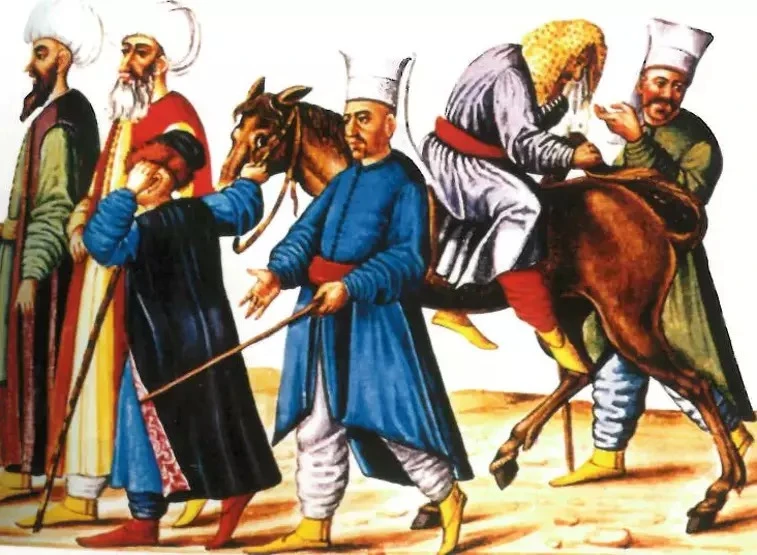
One of the most striking punishments described by contemporary observers was public shaming through symbolic degradation. The Italian-born French writer Teodoro Spandugino, in his chronicle La Genealogie du Grand Turc, provides the following account:
“If a dhimmi (a non-Muslim subject) committed adultery with a Turkish woman and did not convert to Islam, he would be burned. If a dhimmi or a Muslim Turk were caught committing adultery with a dhimmi woman, both the man and the woman would be seated backwards on a donkey, a sheep’s tripe wrapped around their heads, and they would be paraded through the streets holding the donkey’s tail like a bridle.”
The inversion of posture (riding backwards), the use of animal entrails, and the public procession were all intended to create moral disgrace. The punishment functioned as a performative assertion of communal norms and religious hierarchy.
A similar episode appears in the 17th-century travel account of Evliya Çelebi, the Seyahatnâme:
“They seized a Gypsy woman and a Jew together and, through torture, made them confess their crime. They dressed the Gypsy woman in filthy tripe and placed her backwards on a donkey. The Jew was placed on another donkey for punishment. When they passed through the streets, such cries and mimicry arose that one could hardly refrain from laughter.”
Evliya’s use of the term “spectacle” suggests that such punishments were staged as public theater, reinforcing communal boundaries and moral expectations.
Monetary Fines: The Kanunname of Mehmed II
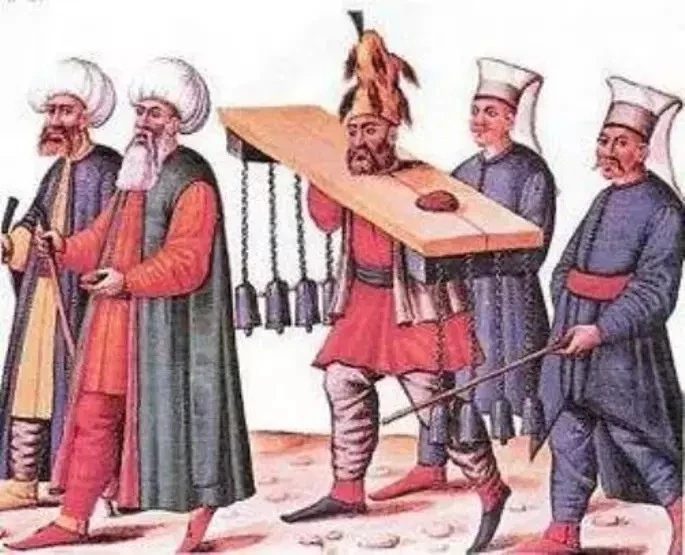
Under Fatih Sultan Mehmed reign, adultery was addressed in the imperial law code (Kanunname) through wealth-based financial penalties:
“If a married person commits adultery and the act is proven, and if he possesses wealth amounting to one thousand akçe, he shall pay three hundred akçe. If his wealth amounts to six hundred akçe, he shall pay two hundred; if less, then one hundred, fifty, or forty akçe according to his means.”
The proportional nature of the fine indicates that adultery was treated partly as a compensable offense within the sphere of administrative (örfî) law.
The same code (Article 9) penalized lesser forms of sexual misconduct:
“If a man kisses another man’s wife, makes improper requests, or physically grabs her, the judge shall order flogging and collect one akçe for each stroke.”
This demonstrates that harassment and non-consensual contact were also subject to judicial sanction.
Severe Corporal Punishments: Bayezid II
The general code of II. Bayezid (Article 26) prescribed significantly harsher penalties for abduction and sexual violence:
“Whoever abducts a girl or a boy, or unlawfully enters another’s home in betrayal, shall have his organ cut off. If he marries the abducted woman or girl, the marriage shall immediately be annulled; his beard shall be shaved and he shall be beaten with sticks. If caught together with the woman, he shall be executed at once.”
The phrase “cutting the organ” refers to genital mutilation, reflecting the gravity attributed to coercive sexual crimes. Beard shaving was a symbolic act of dishonor, undermining masculine status and social standing.
Kanuni Sultan Suleyman: Consent and Liability
The law code of Kanuni Sultan Süleyman reinforced similar provisions. Article 5 states:
“Those who abduct boys or girls, those who enter homes treacherously, and those who attempt to seize women or girls shall have their organs cut off. If a man seizes a woman or girl without her consent, his organ shall be cut off and the woman or girl shall not be blamed in any way.”
This clause is notable for explicitly exempting a non-consenting woman from liability.
However, the same article continues:
“But if the woman or girl consents and leaves her home by agreement with the man, her organ shall be branded.”
Thus, consensual extramarital conduct could expose women to corporal punishment as well.
Article 6 adds:
“If someone abducts a girl or woman and forces a marriage, the marriage shall be annulled by force; the man’s beard shall be shaved and he shall receive severe flogging.”

Oaths and Evidentiary Procedure
Article 10 of Mehmed II’s code addresses evidentiary disputes:
“If a woman or girl accuses a man of adultery and he denies it, neither statement shall be accepted outright. The man shall be required to swear an oath. If he swears that he did not commit the act, the woman shall be flogged and fined one akçe for every two strokes. But if the man confesses and the woman denies it, the woman shall be required to swear. If she insists that he committed the act, the man shall be flogged and fined.”
This procedure reflects the interaction between Islamic evidentiary principles (oath and confession) and Ottoman administrative law.
In the 15th and 16th centuries, sexual offenses in the Ottoman Empire were addressed through a layered system of sanctions that included:
- Public humiliation (backwards donkey parades, use of animal entrails),
- Wealth-proportional monetary fines,
- Flogging and symbolic degradation (beard shaving),
- Genital mutilation and branding,
- Capital punishment in aggravated cases.
Accounts by Spandugino and Evliya Çelebi, when read alongside imperial law codes, indicate that adultery and sexual misconduct were framed not only as moral violations but as threats to social hierarchy, religious order, and public stability.